

रेडियोसक्रियता (रेडियोऐक्टिविटी / radioactivity) या रेडियोधर्मिता वह प्रकिया होती है जिसमें एक अस्थिर परमाणु अपने नाभिक (न्यूक्लियस) से आयनकारी विकिरण (ionizing radiation) के रूप में ऊर्जा फेंकता है। ऐसे पदार्थ जो स्वयं ही ऐसी ऊर्जा निकालते हों विकिरणशील या रेडियोधर्मी (रेडियोऐक्टिव) कहलाते हैं। रेडियोसक्रियता दो प्रकार की होती है- प्राकृतिक रेडियोसक्रियता तथा कृत्रिम रेडियोसक्रियता। रेडियोसक्रिय तत्वों के परमाणु के नाभिक स्वतः विखंडित होकर अन्य तत्वों के परमाणुओं में परिवर्तित होते रहते हैं।
Q.1) रेडियोधर्मिता की खोज किसने की थी ?Who discovered radioactivity?
A.) रदरफोर्ड /Rutherford B.) हेनरी वेक्वेरेल /Henri Vaquerel C.) रोएंटजेन /Roentgen D.) आइन्स्टाइन /Einstein
View Answer
Explanation: अंटोइन हेनरी बैकेरल (15 दिसम्बर 1852 – 25 अगस्त 1908) एक फ्रांसीसी भौतिकशास्त्री, नोबेल पुरस्कार विजेता और मैरी क्यूरी तथा पियरे क्यूरी के साथ रेडियोधर्मिता के अनवेषक थे, जिसके लिए तीनों को 1903 में भौतिकी में नोबेल पुरस्कार दिया गया।Antoine Henri Becquerel (15 December 1852 – 25 August 1908) was a French physicist, Nobel laureate and co-discoverer of radioactivity with Marie Curie and Pierre Curie, for which all three were awarded the 1903 Nobel Prize in Physics.
Q.2) रेडियो सक्रियता किसका गुण है Radioactivity is the property of
A.) इलेक्ट्रॉन का /Electron B.) प्रोटॉन का /Proton C.) न्यूट्रॉन का /Neutron D.) नाभिक का /Nucleus
View Answer
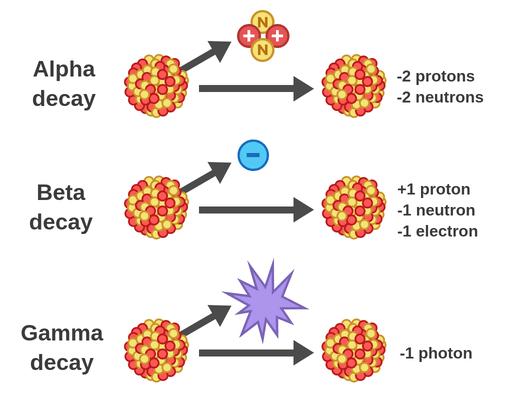
Explanation: रेडियोसक्रियता (रेडियोऐक्टिविटी / radioactivity) या रेडियोधर्मिता वह प्रकिया होती है जिसमें एक अस्थिर परमाणु अपने नाभिक (न्यूक्लियस) से आयनकारी विकिरण (ionizing radiation) के रूप में ऊर्जा फेंकता है। ऐसे पदार्थ जो स्वयं ही ऐसी ऊर्जा निकालते हों विकिरणशील या रेडियोधर्मी कहलाते हैं। यह विकिरण अल्फा कण (alpha particles), बीटा कण (beta particle), गामा किरण (gamma rays) और इलेक्ट्रॉनों के रूप में होती है। ऐसे पदार्थ जिनकी परमाण्विक नाभी स्थिर नहीं होती और जो निश्चित मात्रा में आवेशित कणों को छोड़ते हैं, रेडियोधर्मी (रेडियोऐक्टिव) कहलाते हैं।
Q.3) रेडियोसक्रिय परिवर्तन में भाग लेता है participates in radioactive change
A.) परमाणु के संयोजी इलेक्ट्रॉन /Valence electrons of the atom B.) परमाणु के कोर इलेक्ट्रॉन /Core electrons of the atom C.) परमाणु के नाभिक / Nucleus of an atom D.) इनमे से कोई नहीं /None of these
View Answer
Explanation: रेडियोसक्रिय परिवर्तन में परमाणु के नाभिक भाग लेता है।The nucleus of an atom takes part in radioactive changes.
Q.4) किसी परमाणु के स्थाई नाभिक में प्रोटॉन की संख्या होती हैThe number of protons in the stable nucleus of an atom is
A.) न्यूट्रॉन की संख्या के बराबर /Equal to the number of neutrons B.) न्यूट्रॉन की संख्या से अधिक /more than the number of neutrons C.) न्यूट्रॉन की संख्या से कम /less than the number of neutrons D.) इसमे से कोई नहीं /None of these
View Answer
Explanation: किसी परमाणु के स्थाई नाभिक में प्रोटॉन की संख्या न्यूट्रॉन की संख्या से कम होती है।The number of protons in the stable nucleus of an atom is less than the number of neutrons.
Q.5) रेडियोधर्मिता की यूनिट हैunit of radioactivity is
A.) ऐंग्स्ट्रॉम /Angstrom B.) कैंडेला / Candela C.) फर्मी /Fermi D.) क्युरी / Curie
View Answer
Explanation: रेडियोधर्मिता का यूनिट क्यूरी (Curie) है।The unit of radioactivity is Curie.
Q.6) रेडियोधर्मी तत्व किसका उत्सर्जन करती हैWhat emits radioactive element
A.) पराबैंगनी किरणों का /Ultraviolet rays B.) α , β तथा γ विकिरण /α , β and γ radiation C.) रेडियो तरंगे /Radio waves D.) अवरक्त तरंगे /Infrared waves
View Answer
Explanation: रेडियोसक्रियता (रेडियोऐक्टिविटी / radioactivity) या रेडियोधर्मिता वह प्रकिया होती है जिसमें एक अस्थिर परमाणु अपने नाभिक (न्यूक्लियस) से आयनकारी विकिरण (ionizing radiation) के रूप में ऊर्जा फेंकता है। ऐसे पदार्थ जो स्वयं ही ऐसी ऊर्जा निकालते हों विकिरणशील या रेडियोधर्मी कहलाते हैं। यह विकिरण अल्फा कण (alpha particles), बीटा कण (beta particle), गामा किरण (gamma rays) और इलेक्ट्रॉनों के रूप में होती है। ऐसे पदार्थ जिनकी परमाण्विक नाभी स्थिर नहीं होती और जो निश्चित मात्रा में आवेशित कणों को छोड़ते हैं, रेडियोधर्मी (रेडियोऐक्टिव) कहलाते हैं।Radioactivity is the process by which an unstable atom emits energy in the form of ionizing radiation from its nucleus. Substances that themselves emit such energy are called radiative or radioactive. This radiation is in the form of alpha particles, beta particles, gamma rays and electrons. Substances whose atomic nucleus is not stable and which release a certain amount of charged particles are called radioactive.
Q.7) अल्फा और β किरणों की खोज किसने की थी Who discovered alpha and beta rays
A.) डॉल्टन /Dalton B.) रौंटजन /Roentgen C.) रौंटजन /Roentgen D.) विलार्ड /Willard
View Answer
Explanation: अर्नेस्ट रदरफोर्ड (30 अगस्त 1871 31 अक्टूबर 1937) प्रसिद्ध रसायनज्ञ तथा भौतिकशास्त्री थे। उन्हें नाभिकीय भौतिकी का जनक माना जाता है। भौतिक रसायन के लगभग सभी प्रयोगों में उपयोग होने वाली अल्फा, बीटा और गामा किरणों के बीच अन्तर बताने वाले वैज्ञानिक अर्नेस्ट रदरफोर्ड ही थे।Ernest Rutherford (30 August 1871 – 31 October 1937) was a renowned chemist and physicist. He is considered the father of nuclear physics. Ernest Rutherford was the scientist who told the difference between alpha, beta and gamma rays used in almost all the experiments of physical chemistry.
Q.8) किस वज्ञानिक ने γ किरणों की खोज की Which scientist discovered γ rays
A.) विलार्ड ने /Willard B.) रदरफोर्ड /Rutherford C.) रौंटजन /Roentgen D.) डॉल्टन /Dalton
View Answer
Explanation: अर्नेस्ट रदरफोर्ड (30 अगस्त 1871 31 अक्टूबर 1937) प्रसिद्ध रसायनज्ञ तथा भौतिकशास्त्री थे। उन्हें नाभिकीय भौतिकी का जनक माना जाता है। भौतिक रसायन के लगभग सभी प्रयोगों में उपयोग होने वाली अल्फा, बीटा और गामा किरणों के बीच अन्तर बताने वाले वैज्ञानिक अर्नेस्ट रदरफोर्ड ही थे।Ernest Rutherford (30 August 1871 – 31 October 1937) was a renowned chemist and physicist. He is considered the father of nuclear physics. Ernest Rutherford was the scientist who told the difference between alpha, beta and gamma rays used in almost all the experiments of physical chemistry.
Q.9) निम्न में कौन रेडियोसक्रिय किरण हीलियम नाभिक के समकक्ष होता है Which of the following radioactive ray is equivalent to helium nucleus?
A.) α किरण /α ray B.) β किरण /β ray C.) γ किरण /γ ray D.) इनमे से कोई नहीं /None of these
View Answer
Explanation: अल्फा किरण हीलियम नाभिक के समकक्ष होता है। अल्फा (a) कण मुख्यत हीलियम नाभिक होते हैं। इनकी संरचना दो प्रोटानो व दो न्यूट्रानों के द्वारा होती हैं। रेडियो धर्मिता में ये कण नाभिक से उत्सर्जित होते हैं।Alpha rays are equivalent to helium nuclei. Alpha (a) particles are mainly helium nuclei. They are composed of two protons and two neutrons. In radioactivity, these particles are emitted from the nucleus.
Q.10) नाभिक से निकलने वाले विकिरण में किसकी वेधन क्षमता सर्वाधिक होती हैWhich has the highest penetrating ability in the radiation emanating from the nucleus?
A.) α किरण में /in α ray B.) β किरण में /β ray C.) γ किरण में /γ ray D.) इनमे से कोई नहीं / None of these
View Answer
Explanation: इस प्रक्रिया को गामा क्षय (gamma decay) कहा जाता है। अपने ऊँचे ऊर्जा स्तर के कारण, जैविक कोशिका द्वारा सोख लिए जाने पर अत्यंत नुकसान पहुँचा सकती हैं। गामा किरण नाभिक में से अल्फा और बीटा के निकलने से बनता है। यह सबसे अधिक वेधन छमता वाला किरण होता है।This process is called gamma decay. Due to their high energy level, they can cause significant damage if absorbed by biological cells. Gamma rays are created by the release of alpha and beta from the nucleus. It is the most penetrating ray.