
Nouns in English Grammar
Meaning, Categories & Usage Rules with Fresh Examples
Noun and Its Categories
In this lesson, we will study the meaning of noun and its various categories with suitable examples. This chapter is part of an ongoing English Grammar series explained in Hindi. Here, nouns will be explained from the basic level to the advanced level in a simple and clear manner. Let us begin our learning journey with nouns.

Noun (संज्ञा)
A Noun is a word that is used to name a person, place, object, quality, action, or state.
(किसी व्यक्ति, स्थान, वस्तु, गुण, कार्य या अवस्था के नाम को Noun (संज्ञा) कहा जाता है।)
उदाहरण:
Amit, Riya, Jaipur, London, Newton, book, table, gold, teacher, child आदि।
Kinds of Noun
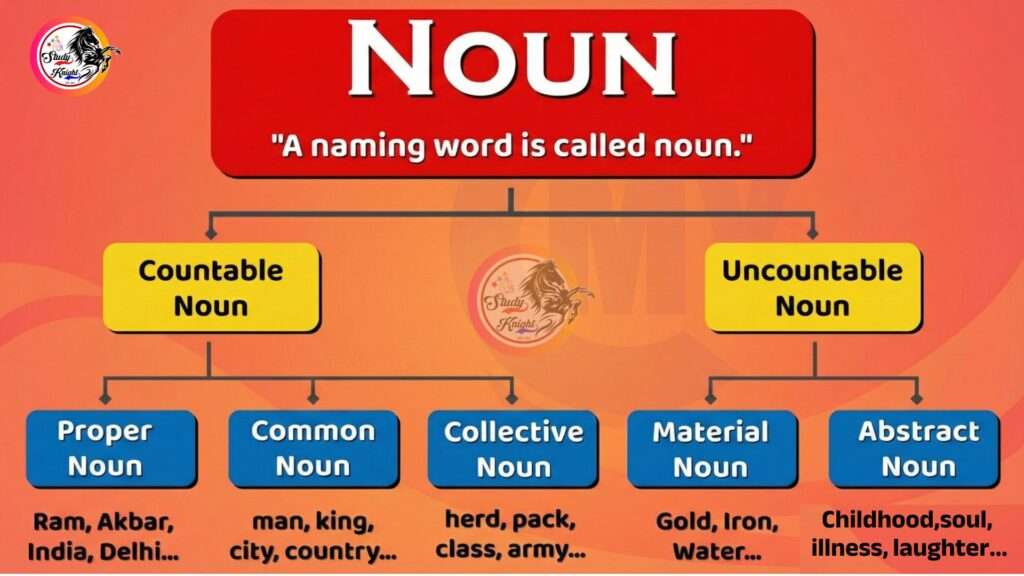
In English grammar, nouns are mainly divided into five categories. A brief introduction to each type is given below:
- Proper Noun (व्यक्तिवाचक संज्ञा)
- Common Noun (जातिवाचक संज्ञा)
- Collective Noun (समूहवाचक संज्ञा)
- Material Noun (द्रव्यवाचक संज्ञा)
- Abstract Noun (भाववाचक संज्ञा)
PROPER NOUN (व्यक्तिवाचक संज्ञा)
Proper Noun से तात्पर्य किसी विशेष व्यक्ति, स्थान या वस्तु के नाम से होता है।
A Proper Noun is the name of a specific person, place, or thing.
उदाहरण:
Rohit, Mumbai, Neha, Taj Mahal आदि।
Examples in Sentences
- Rohit plays cricket very well.
- She visited Mumbai last year.
🔹 Note: Proper Nouns हमेशा Capital letter से शुरू होते हैं।
Proper Noun used as Common Noun
- Virat is the Tendulkar of modern cricket.
- Kalidas is known as the Shakespeare of India.
COMMON NOUN (जातिवाचक संज्ञा)
जिस संज्ञा से एक ही जाति या वर्ग के सभी व्यक्ति या वस्तुओं का बोध हो, उसे Common Noun कहते हैं।
A Common Noun is a general name given to every person or thing of the same kind.
उदाहरण:
teacher, student, river, city, animal आदि।
Examples in Sentences
- The child is playing in the park.
- These cities are very crowded.
COLLECTIVE NOUN (समूहवाचक संज्ञा)
जिस संज्ञा से व्यक्तियों या वस्तुओं के समूह का बोध हो, उसे Collective Noun कहते हैं।
A Collective Noun refers to a collection of people or things treated as one unit.
उदाहरण:
team, group, crowd, class, army, family, staff, audience आदि।
Examples
- A bouquet = a collection of flowers
- A crew = a collection of sailors
- A swarm = a collection of bees
- A bundle = a collection of sticks
सामान्यतः Collective Noun का प्रयोग Singular verb के साथ होता है।
Plural verb का प्रयोग तब किया जाता है जब समूह के सदस्य अलग-अलग कार्य कर रहे हों।
Sentence Examples
- The team is winning the match. (एक इकाई)
- The team are arguing among themselves. (मतभेद)
More Examples of Collective Nouns
- a class of learners
- a pack of dogs
- a bunch of flowers
- a flock of sheep
- a convoy of vehicles
- a panel of judges
- a troop of scouts
- a range of hills
- a swarm of insects
- a set of tools
MATERIAL NOUN (पदार्थवाचक संज्ञा)
जिस Noun (संज्ञा) से ऐसे पदार्थ या सामग्री का बोध हो जिनसे अन्य वस्तुएँ बनाई जा सकती हैं, उसे Material Noun (पदार्थवाचक संज्ञा) कहा जाता है।
- A Material Noun refers to a substance, element, or raw material, including metals and ingredients of alloys.
- Grammatically, a material noun denotes a type of substance, not its individual units. Hence, it is generally non-countable, concrete, and commonly used as a common noun.
उदाहरण:
Gold, iron, silver, copper, steel, wood, marble, plastic, water, milk, sand, coal, glass, cement आदि।
Examples in Sentences
- This ring is made of platinum.
- The statue is carved from marble.
- They built the house using cement and steel.
🔹 Note:
Material Nouns सामान्यतः Countable नहीं होते, अर्थात इनकी गिनती नहीं की जाती। इन्हें मापा या तौला जाता है।
इनके साथ अधिकतर Singular verb का प्रयोग होता है और सामान्य रूप से इनके पहले Article (a, an) नहीं लगाया जाता।
ABSTRACT NOUN (भाववाचक संज्ञा)
Abstract Noun ऐसे गुण, भाव, क्रिया या अवस्था को दर्शाता है जिन्हें देखा या छुआ नहीं जा सकता, बल्कि केवल अनुभव किया जा सकता है।
An Abstract Noun names a quality, action, or state, considered separately from any physical object.
उदाहरण:
Truth, courage (quality), joy, anger (feeling), childhood, freedom (state) आदि।
Categories of Abstract Nouns
Quality (गुण) | Action (क्रिया) | State (अवस्था) |
Kindness | Decision | Childhood |
Bravery | Movement | Old age |
Honesty | Growth | Freedom |
Patience | Speech | Illness |
Wisdom | Laughter | Poverty |
Confidence | Thinking | Sleep |
Examples in Sentences
- Everyone admired her courage.
- Freedom is precious to every nation.
🔹 Abstract Noun का प्रयोग सामान्यतः Singular form में किया जाता है।
Formation of Abstract Nouns (Abstract Noun का निर्माण)
Abstract Nouns प्रायः Common Nouns, Verbs और Adjectives से विभिन्न suffixes जोड़कर बनाए जाते हैं, जैसे:
–hood, –ship, –ness, –tion, –ity, –ment, –cy, –ism, –th आदि।
(a) From Common Nouns
Common Noun | Abstract Noun | Common Noun | Abstract Noun |
child | childhood | friend | friendship |
leader | leadership | king | kingship |
hero | heroism | owner | ownership |
slave | slavery | citizen | citizenship |
(b) From Verbs
Verb | Abstract Noun | Verb | Abstract Noun |
decide | decision | educate | education |
move | movement | agree | agreement |
judge | judgement | develop | development |
think | thought | act | action |
(c) From Adjectives
Adjective | Abstract Noun | Adjective | Abstract Noun |
kind | kindness | honest | honesty |
strong | strength | happy | happiness |
deep | depth | brave | bravery |
true | truth | wide | width |
Compound Nouns: Meaning, Types & Clear Differences (Rewritten Version)
Compound Nouns
What are Compound Nouns?
Compound Nouns are nouns that are formed by joining two or more words to create a single meaningful noun. These words may be nouns, adjectives, or other parts of speech.
Examples:
classroom, policeman, grandmother, notebook, raincoat, toothbrush etc.
Examples in Sentences
- The teacher explained the lesson using the whiteboard.
- The postman delivered the letter early in the morning.
In the above sentences, whiteboard and postman are compound nouns formed by combining two words:
white + board, post + man
Some More Compound Nouns
Compound Noun | Formation |
housekeeper | house + keeper |
stepfather | step + father |
sunflower | sun + flower |
handbag | hand + bag |
toothbrush | tooth + brush |
bookshelf | book + shelf |
rainfall | rain + fall |
CONCRETE NOUN
A Concrete Noun refers to something that has a physical existence and can be experienced through the five senses (sight, sound, smell, taste, and touch). These nouns represent tangible objects.
Examples:
Dog, chair, phone, apple, river, pen, bottle, computer, tree etc.
Examples in Sentences
- The child picked up a stone from the road.
- My brother bought a new mobile phone.
- The smell of fresh coffee spread across the room.
- The carpenter repaired the wooden table.
These nouns denote real-world objects that can be directly seen or touched.
Concrete Nouns vs Abstract Nouns
Lorem ipsum dolor sit amet, consectetur adipiscing elit. Ut elit tellus, luctus nec ullamcorper mattis, pulvinar dapibus leo.
Concrete Nouns refer to things that are physical and observable.
Examples: chair, dog, car, book, flower
Abstract Nouns, on the other hand, refer to ideas, feelings, or qualities that cannot be seen or touched.
Examples: love, fear, honesty, courage, freedom
Example Sentence
- The girl hugged her doll with happiness in her heart.
Here, doll is a concrete noun because it is a physical object, while happiness is an abstract noun because it is a feeling.
Compound Nouns vs Collective Nouns
Compound Nouns
Compound nouns are created by combining two or more words into one noun. They may be written as:
- one word (football)
- hyphenated (mother-in-law)
- separate words (bus stop)
Examples:
school bag, ice cream, railway station, sunrise
Collective Nouns
Collective nouns are used to name a group of people, animals, or things considered as a single unit.
Examples:
team, class, herd, flock, family
Usage Examples:
- A team of players won the match.
- A flock of birds flew across the sky.
🔹 Difference:
Compound noun = combination of words
Collective noun = group treated as one
Count Nouns vs Non-Count Nouns
Countable Nouns
Those nouns which can be counted are called Countable Nouns.
जिन संज्ञाओं की गिनती की जा सकती है, उन्हें Countable Noun कहते हैं।
Examples:
books, pens, chairs, students, apples
They have singular and plural forms.
We use a/an with singular countable nouns and ask “How many?” for quantity.
Singular–Plural Forms
Singular | Plural |
one dog | two dogs |
one child | two children |
one box | two boxes |
one car | three cars |
one bird | five birds |
Examples in Sentences
- She owns four dogs.
- I bought a pen yesterday.
- He needs two notebooks for class.
- How many students are present today?
Uncountable Nouns: Meaning, Rules & Correct Usage (Rewritten & Copyright-Safe)
Uncountable Noun (अगणनीय संज्ञा)
वे संज्ञाएँ जिनकी गिनती नहीं की जा सकती, लेकिन जिन्हें मापा या तौला जा सकता है, Uncountable Nouns कहलाती हैं।
जिन संज्ञा शब्दों को गिना नहीं जा सकता, उन्हें Uncountable Noun (अगणनीय संज्ञा) कहते हैं।
Examples:
milk, water, rice, sugar, gold, bread, air आदि।
🔹 सामान्य रूप से Uncountable Nouns किसी अविभाज्य सम्पूर्ण वस्तु को दर्शाते हैं, इसलिए इन्हें कभी-कभी Mass Nouns भी कहा जाता है।
Uncountable nouns का प्रयोग किसी गुण, क्रिया, पदार्थ या वस्तु के लिए किया जाता है जिसे डाला, मापा या तौला जा सके। ये किसी पूरे वर्ग या समूह का भी बोध कराते हैं।
👉 Uncountable Nouns हमेशा Singular होते हैं और इनके साथ Singular verb का ही प्रयोग किया जाता है।
Examples in Sentences
- There is some coffee left in the mug.
- This equipment is very useful for training.
Common Types of Uncountable Nouns
Things | Qualities | Actions | Fields of Study |
water | honesty | running | physics |
money | patience | writing | geography |
furniture | courage | speaking | sociology |
homework | loyalty | driving | economics |
advice | wisdom | walking | philosophy |
information | kindness | typing | psychology |
dust | bravery | – | literature |
Important Rules of Uncountable Nouns
❌ Uncountable nouns के साथ a / an का प्रयोग नहीं किया जाता।
जैसे: water, sugar, rice, air, knowledge, beauty, money, evidence आदि।
✔ मात्रा बताने के लिए इन शब्दों का प्रयोग किया जाता है:
some, much, a lot of, a little, a great deal of
या फिर माप के शब्द:
a glass of, a packet of, 500g of, 1 litre of, a spoon of, a pinch of
Examples
- He added a little salt to the soup.
- She shared some useful information with us.
- Please bring two bags of rice.
👉 Quantity पूछने के लिए प्रश्न होता है: How much?
- How much milk do you need?
- There isn’t much time left.
Special Uncountable Nouns in English
कुछ nouns दूसरी भाषाओं में countable होते हैं, लेकिन English में uncountable माने जाते हैं:
accommodation, advice, baggage, bread, furniture, information, luggage, news, progress, traffic, weather, work, travel, trouble
Examples
- He gave me some advice.
- We made good progress this week.
- How much bread should we buy?
Use of ‘Hair’ (Special Case)
🔹 Hair सामान्यतः Uncountable होता है।
लेकिन जब एक-एक बाल की बात हो, तब यह Countable बन जाता है।
- Her hair is very shiny.
- I found a hair on the table.
- He has a few grey hairs now.
Other Important Rules of Nouns
Rule 1: Always Used in Plural Form
कुछ nouns हमेशा Plural में ही प्रयोग होते हैं, इन्हें singular नहीं बनाया जा सकता:
scissors, trousers, pants, spectacles, goggles, shorts, pliers, tongs, belongings, savings, surroundings, thanks, wages, riches, proceeds, valuables आदि।
Examples
- Where are my glasses?
- The wages were paid yesterday.
- His belongings were stolen.
🔸 Note:
Wages का प्रयोग दोनों रूपों में हो सकता है:
- Wages are paid weekly. (मजदूरी)
- The wages of honesty is respect. (परिणाम)
Rule 2: Plural in Form but Singular in Meaning
कुछ nouns दिखने में plural लगते हैं, लेकिन Singular verb लेते हैं:
news, politics, economics, physics, mathematics, ethics, measles, mumps, innings, athletics
Examples
- The news is shocking.
- Mathematics is my favourite subject.
Rule 3: Singular in Form but Plural in Meaning
कुछ nouns दिखने में singular होते हैं, लेकिन प्रयोग हमेशा Plural में होता है:
cattle, police, people, poultry, children, gentry, infantry, cavalry
❌ गलत: cattles, childrens
✔ सही: cattle, children
वाक्यों में प्रयोग (Examples in Sentences)
- Cattle are moving slowly across the pasture.
- Our infantry have advanced towards the border.
- The police have caught the criminals.
🔹 नोट:
People का अर्थ होता है लोग।
Peoples का प्रयोग विभिन्न मूलवंश या नस्लों (different races) के लोगों के लिए किया जाता है।
Rule 4: केवल Singular रूप में प्रयुक्त होने वाले Nouns
कुछ संज्ञाओं का प्रयोग हमेशा Singular form में ही किया जाता है। ये सभी Uncountable Nouns होते हैं और इनके साथ A / An का प्रयोग नहीं किया जाता।
Examples:
scenery, poetry, furniture, advice, information, hair, business, mischief, bread, stationery, crockery, luggage, baggage, postage, knowledge, wastage, jewellery, breakage, equipment, work, evidence, fuel, cost आदि।
वाक्यों में प्रयोग
- The scenery of Himachal is breathtaking.
- I don’t have any information about the event.
- His mischief caused serious trouble.
- Her hair looks very smooth.
- We purchased some new equipment for the lab.
❌ गलत: sceneries, informations, furnitures, hairs
✔ सही: scenery, information, furniture, hair
Singular/Plural अर्थ व्यक्त करने का तरीका
जब इन nouns के singular या plural अर्थ व्यक्त करने हों, तो इनके साथ कुछ measure words जोड़े जाते हैं:
- She shared a piece of information.
- Several pieces of information were incorrect.
- Different types of furniture are sold here.
- He bought a few items of jewellery.
- She ate two slices of bread.
- Please hand me some articles of stationery.
- The police found a strand of hair inside the vehicle.
🔹 Note:
Money का plural form monies हो सकता है, जिसका अर्थ होता है राशियाँ (sums of money)।
- The monies were donated to charity.
Rule 5: Singular और Plural दोनों में समान रूप वाले Nouns
कुछ nouns ऐसे होते हैं जिनका Singular और Plural रूप एक जैसा रहता है:
deer, sheep, series, species, fish, crew, team, jury, aircraft, counsel आदि।
Examples
- Our team is performing excellently.
- The team are discussing their strategies.
- There are two fish in the pond.
- Different fishes live in this aquarium.
(fishes = विभिन्न प्रजातियाँ)
Rule 6: Hyphenated Nouns और Plural Form
Hyphenated nouns में सामान्यतः पहला शब्द plural नहीं किया जाता।
❌ गलत → ✔ सही
- two hundred-rupees notes → two hundred-rupee notes
- five-stars hotels → five-star hotels
Rule 7: आम बोल-चाल में होने वाली गलतियाँ
कुछ nouns का प्रयोग लोग अक्सर गलत करते हैं। नीचे सही और गलत प्रयोग दिए गए हैं:
गलत प्रयोग | सही प्रयोग |
Cousin brother / cousin sister | Cousin |
Pickpocketer | Pickpocket |
Good name | Name |
Big / small blunder | Blunder |
Strong breeze | Strong wind |
Bad dream | Nightmare |
Proudy | Proud |
Commonly Confused Nouns
- Floor – फर्श
- Ground – जमीन
- Skill – अभ्यास से सीखी हुई क्षमता
- Talent – जन्मजात क्षमता
- Envy – दूसरों की वस्तु देखकर होने वाली ईर्ष्या
- Jealousy – अपनी वस्तु खोने के डर से होने वाली ईर्ष्या
Rule 8: निश्चित संख्या के साथ प्रयुक्त Nouns
कुछ Nouns अर्थ में तो Plural होते हैं, लेकिन जब इनके पहले Definite Numeral Adjective (जैसे two, three, five आदि) आता है, तो इन nouns को Plural नहीं बनाया जाता।
Examples of such nouns:
pair, score, gross, stone, hundred, dozen, thousand, million, billion आदि।
वाक्यों में प्रयोग
- I have three hundred pages to read.
- She bought two dozen eggs.
- He invested five million rupees in the project.
🔹 लेकिन जब इनके साथ Indefinite expressions का प्रयोग होता है, तो इन्हें Plural किया जाता है।
Examples:
dozens of students, hundreds of houses, millions of people, scores of books, many pairs of shoes
वाक्यों में प्रयोग
- Hundreds of students participated in the competition.
- He earned millions of rupees through business.
- I bought two pairs of shoes. (of के कारण pairs का प्रयोग)
Rule 9: Noun + Preposition + Noun Structure
यदि किसी Noun के बाद कोई Preposition आए और फिर वही Noun दोबारा आए, तो दोनों बार Singular form का ही प्रयोग किया जाता है।
Examples
- Village after village was destroyed.
- Line upon line of text was printed.
- He went from house to house.
- Train after train is arriving at the station.
❌ गलत: villages after villages, houses to houses
✔ सही: village after village, house to house
Rule 10: Common Gender Nouns (Dual Gender Nouns)
कुछ nouns ऐसे होते हैं जिनका प्रयोग पुरुष और स्त्री दोनों के लिए किया जा सकता है। इन्हें Common Gender Nouns या Dual Gender Nouns कहा जाता है।
Examples:
teacher, student, child, doctor, lawyer, worker, writer, leader, artist, musician आदि।
जब ऐसे nouns Singular में प्रयोग होते हैं, तो परंपरागत रूप से he / his / him का प्रयोग किया जाता रहा है:
- Every student must do his homework.
- A leader should perform his responsibilities honestly.
🔹 आधुनिक अंग्रेज़ी में, विशेषकर legal या formal contexts में, स्पष्टता के लिए his or her या they / their का प्रयोग भी किया जाता है।
Possessive Nouns (अधिकार सूचक संज्ञा)
Possessive Nouns का प्रयोग किसी वस्तु पर स्वामित्व या अधिकार दर्शाने के लिए किया जाता है। ये सामान्यतः noun के अंत में apostrophe + s (’s) लगाकर बनाए जाते हैं।
Examples
- Rahul’s bike is new.
- The dog’s collar is red.
- The company’s growth is impressive.
- The children’s toys are everywhere.
- My cousin’s room is very spacious.
- The book’s pages are torn.
- The teachers’ meeting was postponed. (plural possessive)
🔹 जिन plural nouns के अंत में पहले से s हो, उनके साथ केवल apostrophe (’) लगाया जाता है।
Possessive Pronouns
जब noun का प्रयोग न करके सीधे स्वामित्व बताया जाता है, तो Possessive Pronouns का प्रयोग किया जाता है।
Forms of Pronouns
Nominative | Accusative | Possessive |
I | me | my / mine |
we | us | our / ours |
he | him | his |
she | her | her / hers |
you | you | your / yours |
they | them | their / theirs |
who | whom | whose |
Examples
- This notebook is mine.
- Is that bicycle hers?
- The victory is ours.
Possessive nouns और possessive pronouns वाक्यों में ownership स्पष्ट करने के लिए अत्यंत आवश्यक होते हैं।
Must-Read Noun Topics (Exam Point of View)
- Gender
- Number (Singular & Plural)
- Case
- Countable & Uncountable Nouns
- Words Showing Groups (Collective Nouns)

FAQs on Nouns
What is a noun?
A noun is a word that names a person, place, object, or concept. It is a fundamental part of English grammar. Nouns may refer to physical things like chair or bird, or ideas and feelings like honesty or joy.
How can you recognize a noun in a sentence?
To spot a noun, ask questions such as “who?” or “what?” about the sentence.
For example, in the sentence “The child is laughing,” the word child is a noun because it answers the question who is laughing?
What are common nouns and proper nouns?
A common noun is a general name used for any person, place, or thing, such as school, river, or teacher.
A proper noun is a specific name of a particular person, place, or thing and always begins with a capital letter, like Delhi, Mahatma Gandhi, or The Taj Mahal.
What is the difference between countable and uncountable nouns?
Countable nouns are those that can be counted and have both singular and plural forms, such as pen/pens or student/students.
Uncountable nouns cannot be counted individually and usually do not have a plural form. They refer to substances, qualities, or ideas, for example milk, information, or wisdom.
Can a noun work as different parts of speech?
Yes, depending on its position and use, a noun can perform different roles in a sentence.
- As a subject: Books are useful.
- As an object: She bought a book.
- As the object of a preposition: He sat near the table.
Additionally, nouns can sometimes act like adjectives when they describe another noun, such as coffee cup or school uniform.