
Pronoun in English Grammar – Concept, Types, Rules and Examples
What is a Pronoun? | Pronoun क्या होता है?
Welcome to the Pronoun chapter of English Grammar.
In this chapter, we will understand how pronouns make language clear, effective, and free from repetition. From personal pronouns to relative pronouns, all important categories are explained here with simple and exam-friendly examples.
What is a Pronoun? | Pronoun क्या होता है?
Welcome to the Pronoun chapter of English Grammar.
In this chapter, we will understand how pronouns make language clear, effective, and free from repetition. From personal pronouns to relative pronouns, all important categories are explained here with simple and exam-friendly examples.
Pronoun (सर्वनाम):
जो शब्द संज्ञा (Noun) के स्थान पर प्रयोग किया जाता है, उसे सर्वनाम (Pronoun) कहते हैं।
Why are Pronouns used? | सर्वनाम का प्रयोग क्यों किया जाता है?
यदि किसी वाक्य में एक ही संज्ञा का बार-बार प्रयोग किया जाए, तो वाक्य भारी और असुंदर प्रतीत होता है।
इसी दोहराव से बचने के लिए Pronoun का प्रयोग किया जाता है।
Example:
- Rohit is a skilled player. He performs well in every match.
(यहाँ He, संज्ञा Rohit के स्थान पर प्रयुक्त हुआ है।)
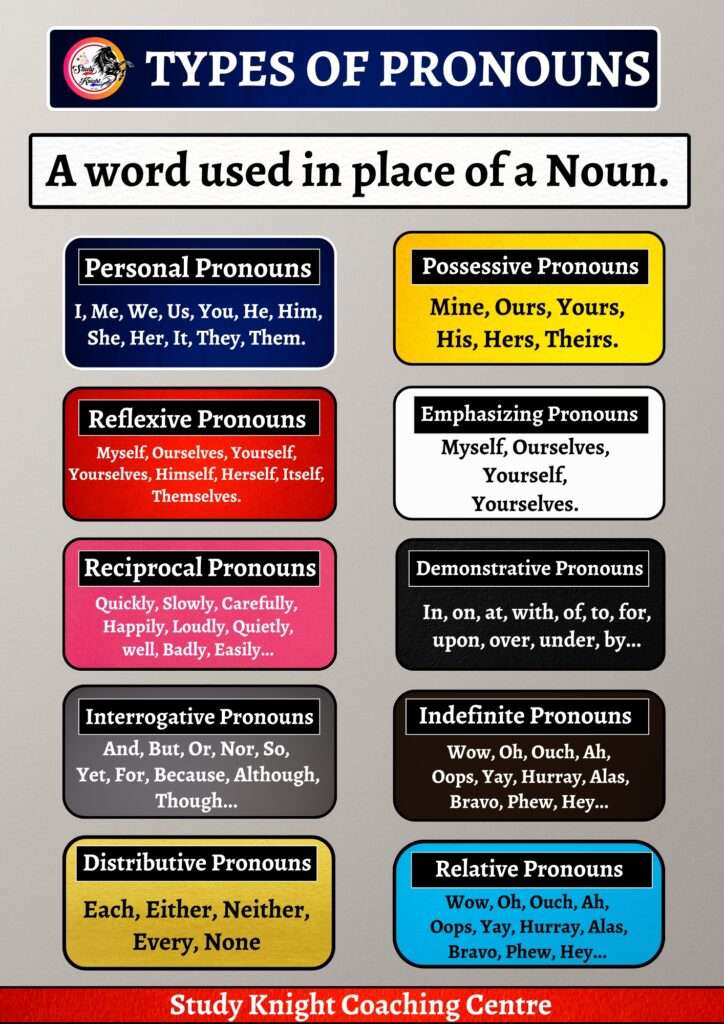
Types of Pronouns | सर्वनाम के प्रकार
- Personal Pronouns (पुरुषवाचक सर्वनाम)
These pronouns refer directly to the speaker, listener, or person/thing spoken about.
Examples:
I, me, we, us, you, he, him, she, her, it, they, them
Sentence:
- She is preparing for the examination.
- Possessive Pronouns (अधिकारवाचक सर्वनाम)
These pronouns show ownership or possession.
Examples:
mine, ours, yours, his, hers, theirs
Sentence:
- That notebook is theirs.
- Reflexive Pronouns (निजवाचक सर्वनाम)
When the subject and object are the same, reflexive pronouns are used.
Examples:
myself, yourself, himself, herself, itself, ourselves, themselves
Sentence:
- The child hurt himself while playing.
- Emphatic / Emphasizing Pronouns (दबावसूचक सर्वनाम)
When a reflexive pronoun is used to give emphasis to the subject, it becomes an emphatic pronoun.
Sentence:
- The principal himself announced the result.
- Reciprocal Pronouns (पारस्परिक संबंधवाचक सर्वनाम)
These pronouns show a mutual action or relationship.
Examples:
each other, one another
Sentence:
- The two sisters support each other.
- Demonstrative Pronouns (संकेतवाचक सर्वनाम)
These pronouns are used to point out specific persons or things.
Examples:
this, that, these, those
Sentence:
- Those are historical monuments.
- Interrogative Pronouns (प्रश्नवाचक सर्वनाम)
These pronouns are used to ask questions.
Examples:
who, whom, whose, which, what
Sentence:
- Who is responsible for this work?
- Indefinite Pronouns (अनिश्चयवाचक सर्वनाम)
These pronouns refer to non-specific or unknown persons or things.
Examples:
someone, anyone, nobody, everybody, something, nothing, everything, all, some, any, much, few, little
Sentence:
- Someone is waiting outside.
- Distributive Pronouns (व्यष्टिवाचक सर्वनाम)
These pronouns refer to members of a group one by one.
Examples:
each, either, neither, every, none
Sentence:
- Each student received an identity card.
- Relative Pronouns (संबंधवाचक सर्वनाम)
These pronouns are used to join two clauses.
Examples:
who, whom, whose, which, that
Sentence:
- This is the teacher who inspired me the most.
Personal Pronoun – Meaning, Types and Examples
What is a Personal Pronoun? | Personal Pronoun क्या होता है?
A personal pronoun is used in place of a noun to refer to a person, animal, or thing and helps avoid repetition.
Common Personal Pronouns:
I, you, he, she, it, we, they
Personal Pronouns Indicate (व्यक्त करते हैं):
- First Person (उत्तम पुरुष) – Speaker
👉 I, We - Second Person (मध्यम पुरुष) – Listener
👉 You - Third Person (अन्य पुरुष) – Person or thing spoken about
👉 He, She, It, They
पुरुषवाचक सर्वनाम (Personal Pronoun in Hindi)
पुरुषवाचक सर्वनाम वे शब्द होते हैं जो संज्ञा के स्थान पर प्रयोग होकर व्यक्ति, प्राणी या वस्तु का बोध कराते हैं।
इनसे पुल्लिंग, स्त्रीलिंग अथवा निर्जीव वस्तु का ज्ञान होता है।
Examples of Personal Pronouns (उदाहरण):
- I am preparing for the exam.
(मैं परीक्षा की तैयारी कर रहा हूँ।) - You are very helpful.
(तुम / आप बहुत सहायक हो।) - We completed our homework.
(हमने अपना गृहकार्य पूरा कर लिया।) - They are watching a movie.
(वे फिल्म देख रहे हैं।) - He won the competition.
(वह प्रतियोगिता जीत गया।) - She teaches English grammar.
(वह अंग्रेज़ी व्याकरण पढ़ाती है।) - It is sleeping under the table.
(वह मेज़ के नीचे सो रहा है।) - It looks very expensive.
(यह बहुत महँगा लगता है।)
Types of Personal Pronouns | Personal Pronoun के प्रकार Personal Pronouns मुख्य रूप से तीन प्रकार के होते हैं—
- First Person (उत्तम पुरुष)
First Person Pronoun का प्रयोग बोलने वाले व्यक्ति (Speaker) के लिए किया जाता है।
Examples:
- I – एकवचन (Singular)
- We – बहुवचन (Plural)
Sentences:
- I believe in hard work.
- We support our classmates.
- Second Person (मध्यम पुरुष)
Second Person Pronoun का प्रयोग जिससे बात की जा रही हो (Listener), उसके लिए किया जाता है।
Example:
- You
Second Person में केवल You का ही प्रयोग होता है, जो एकवचन और बहुवचन दोनों के लिए प्रयुक्त होता है।
Sentences:
- You are my closest friend. (तुम)
- You explained the topic clearly. (आप)
👉 You का हिंदी अर्थ सम्मान के अनुसार तुम या आप हो सकता है।
- Third Person (अन्य पुरुष)
Third Person Pronoun का प्रयोग उस व्यक्ति, वस्तु या जीव के लिए किया जाता है, जिसके बारे में बात हो रही हो।
Examples:
- He, She, It, They
Sentences:
- He completed the task on time. (पुल्लिंग + एकवचन)
- She participates actively in class. (स्त्रीलिंग + एकवचन)
- It looks very expensive. (नपुंसकलिंग + एकवचन)
- They are waiting outside. (बहुवचन)
Important Points (परीक्षा के लिए उपयोगी):
- He → एकवचन + पुल्लिंग
- She → एकवचन + स्त्रीलिंग
- It → एकवचन + नपुंसकलिंग
- They → बहुवचन
Cases of Personal Pronouns | Personal Pronoun के कारक
Personal Pronouns के Cases (कारक) को समझने के लिए नीचे दी गई तालिका का अध्ययन आवश्यक है।
इससे यह स्पष्ट होता है कि एक ही Pronoun वाक्य में अलग-अलग स्थितियों में अपना रूप बदल लेता है।
(अगले भाग में Subjective, Objective और Possessive Case की Table दी जाएगी।)

Table: Personal Pronoun and Their Cases
Pronoun (सर्वनाम) | Subject Case / Nominative | Object Case / Accusative | Possessive Adjective | Possessive Pronoun |
I | I | me | my | mine |
We | we | us | our | ours |
You | you | you | your | yours |
He | he | him | his | his |
She | she | her | her | hers |
It | it | it | its | — |
They | they | them | their | theirs |
Important Notes on Possessive Case (ध्यान देने योग्य बातें)
✔ I ke saath → my, mine
✔ We ke saath → our, ours
✔ You ke saath → your, yours
✔ She ke saath → her, hers
✔ They ke saath → their, theirs
⚠️ Special Case
- He ke saath sirf his ka hi use hota hai (adjective & pronoun dono ke liye)
- It ke saath sirf its ka use hota hai
- ❌ Its ka koi possessive pronoun form nahi hota
Examples of Personal Pronoun Cases (उदाहरण):
Possessive Pronoun ke roop mein (Pronoun ki tarah):
- That bag is mine.
- The victory was theirs.
- Is this notebook yours?
- The fault was his.
Possessive Adjective ke roop mein (Adjective ki tarah):
- My brother lives abroad.
- Our school is very big.
- Her ideas are creative.
- Their house is near the river.
- His phone is missing.
- Its tail is very long. (animal/object ke liye)
Possessive Pronouns (अधिकारवाचक सर्वनाम)
What is a Possessive Pronoun?
A possessive pronoun is a pronoun that shows ownership or possession. It tells us that something belongs to someone or something.
👉 Ye pronouns noun ke bina use hote hain aur possessive adjectives (my, your, his etc.) ko replace kar dete hain.
Common Possessive Pronouns
Mine, Yours, His, Hers, Ours, Theirs
👉 Note: “Its” ka possessive pronoun form nahi hota.
Hindi + English Definition
Personal Pronoun ke Possessive Case jo noun ke bina, pronoun ki tarah use hote hain, unhe Possessive Pronouns kehte hain।
Table: Personal Pronouns and Possessive Forms
Nominative | Accusative | Possessive Adjective | Possessive Pronoun |
I | me | my | mine |
We | us | our | ours |
You | you | your | yours |
He | him | his | his |
She | her | her | hers |
It | it | its | ❌ |
They | them | their | theirs |
Examples of Possessive Pronouns (New Examples):
- This pen is mine.
- That blue bag is hers.
- The decision was theirs.
- Is this seat yours?
- The responsibility was his.
Reflexive Pronouns (निजवाचक सर्वनाम)
What is a Reflexive Pronoun?
A reflexive pronoun refers back to the subject of the sentence. It is used when the doer and receiver of the action are the same.
👉 Jab subject jo kaam karta hai, uska effect usi par wapas aata hai, tab reflexive pronoun use hota hai.
Common Reflexive Pronouns
Myself, Yourself, Himself, Herself, Itself, Ourselves, Yourselves, Themselves
Formation of Reflexive Pronouns
Personal pronoun ke possessive adjective ke saath self / selves jod kar reflexive pronoun banta hai:
- my + self → myself
- your + self → yourself (ek vyakti)
- her + self → herself
- him + self → himself
- our + selves → ourselves
- your + selves → yourselves (anek vyakti)
- them + selves → themselves
Hindi Definition
Reflexive Pronoun woh pronoun hota hai jisme karta (subject) aur karm (object) ek hi hota hai.
(The action turns back upon the subject itself.)
Examples of Reflexive Pronouns (Changed Examples):
- She blamed herself for the mistake.
- The child hurt himself while playing.
- We enjoyed ourselves at the picnic.
- Don’t praise yourself too much.
- The cat cleaned itself.
Emphatic Pronouns (ज़ोर देने वाले सर्वनाम)
What is an Emphatic Pronoun?
An emphatic pronoun is used to give stress or emphasis to the subject (and sometimes object) of a sentence.
👉 Iska main kaam kisi vyakti ya cheez par extra focus / जोर dena hota hai.
Common Emphatic Pronouns
Myself, Yourself, Himself, Herself, Itself, Ourselves, Yourselves, Themselves
📌 Note:
Jo words Reflexive Pronouns ke liye use hote hain, wahi words Emphatic Pronouns ke roop me bhi use hote hain. Farq sirf use (प्रयोग) ka hota hai.
Hindi Explanation
Emphatic Pronoun ka prayog दृढ़ता, बल या स्वयं ka bhav prakat karne ke liye hota hai.
Isse pata chalta hai ki kaam kisi aur ne nahi, balki subject ne khud kiya hai।
Examples of Emphatic Pronouns (Changed Examples):
- I myself completed the assignment.
(मैंने यह काम स्वयं पूरा किया।) - The principal himself inspected the classrooms.
(प्रधानाचार्य ने स्वयं कक्षाओं का निरीक्षण किया।) - She herself designed the poster.
(उसने पोस्टर खुद डिजाइन किया।) - We ourselves arranged the meeting.
(हमने मीटिंग स्वयं आयोजित की।) - The machine itself stopped working.
(मशीन अपने-आप बंद हो गई।)
Reciprocal Pronouns (परस्परवाचक सर्वनाम)
What is a Reciprocal Pronoun?
A reciprocal pronoun shows a mutual action or relationship between two or more subjects.
👉 Matlab, jo kaam ek karta hai, wahi kaam doosra bhi karta hai — parस्पर।
Common Reciprocal Pronouns
Each other
One another
Hindi Explanation
Jo pronouns do ya do se adhik vyaktiyon ke beech paraspar sambandh dikhate hain, unhe Reciprocal Pronouns kehte hain।
Examples of Reciprocal Pronouns (New Examples):
- The two classmates respect each other.
- All the team members supported one another.
- The twins always help each other.
- The players congratulated one another after the match.
Important Rules (ध्यान रखें):
✔ Each other → do vyaktiyon ke liye
✔ One another → do se adhik vyaktiyon ke liye
✔ Reciprocal pronouns hamesha Objective Case me use hote hain

Demonstrative Pronouns (संकेतवाचक सर्वनाम)
What is a Demonstrative Pronoun?
A demonstrative pronoun is used to point out or indicate a specific person, object, or place.
Common Demonstrative Pronouns
This, That, These, Those
Usage Explanation (English + Hindi)
- This / These → paas ya present cheezon ke liye
- That / Those → door ya distant cheezon ke liye
संकेतवाचक सर्वनाम ka prayog kisi noun ki taraf ishara (संकेत) karne ke liye hota hai।
Examples of Demonstrative Pronouns (Modified Examples):
- This is my notebook.
- These are very comfortable shoes.
- That is an old building.
- Those are beautiful paintings.
Interrogative Pronouns (प्रश्नवाचक सर्वनाम)
What is an Interrogative Pronoun?
An interrogative pronoun is a pronoun that is used to ask questions and obtain information about a person, thing, or idea.
👉 Jo pronoun question banane ke kaam aata hai, use Interrogative Pronoun kehte hain.
Common Interrogative Pronouns
Who, Whom, Whose, Which, What
Usage Explanation (English + Hindi)
- Who → persons ke liye (subject ke roop mein)
- Whom → persons ke liye (object ke roop mein)
- Whose → ownership ya possession batane ke liye
- Which → choice ya selection ke liye (limited options mein se)
- What → cheez, kaam, ya general information ke liye
Hindi Definition
प्रश्नवाचक सर्वनाम (Interrogative Pronoun) woh pronoun hota hai jiska prayog प्रश्न पूछने ke liye kiya jata hai।
Examples of Interrogative Pronouns (Modified Examples):
- What is written on the board?
(बोर्ड पर क्या लिखा है?) - Who is standing outside the room?
(कमरे के बाहर कौन खड़ा है?) - Which is your bag among these?
(इनमें से तुम्हारा बैग कौन-सा है?) - Whose umbrella is lying here?
(यहाँ पड़ी छतरी किसकी है?) - Whom should I contact for help?
(मुझे मदद के लिए किससे संपर्क करना चाहिए?)
Important Rules (ध्यान रखें):
✅ Who / Whom / Whose
- Who → Nominative Case (Subject)
- Whom → Objective Case (Object)
- Whose → Possessive Case
Examples:
- Who called you yesterday?
- Whom are you waiting for?
- Whose mobile is this?
✅ What
“What” ka prayog aam taur par cheez, profession, activity ya concept ke liye hota hai।
- What is your hobby?
- What does she do for a living?
- What happened last night?
✅ Which
“Which” ka use selection ya choice batane ke liye hota hai, chahe person ho, animal ho ya thing.
- Which student answered correctly?
- Which of these pens is yours?
- Which route should we follow?
Special Difference (Very Important for Exams):
- What is your mother?
👉 She is a doctor.
(Profession puchha gaya hai) - Who is your mother?
👉 Mrs. Anjali Sharma.
(Person ka naam puchha gaya hai)
Indefinite Pronoun (अनिश्चयवाचक सर्वनाम)
Definition (परिभाषा)
An Indefinite Pronoun is a pronoun that does not refer to any particular person, object, or quantity.
अनिश्चयवाचक सर्वनाम वह सर्वनाम है जिससे किसी निश्चित व्यक्ति, वस्तु या संख्या का बोध नहीं होता।
Common Indefinite Pronouns
Someone, Anyone, Everyone, Something, Anything, Everything, Nothing, Some, Any, All, None, Many, Few, Several, Others, Both
Examples of Indefinite Pronoun
- Someone is waiting outside.
- Many were selected for the interview.
- All have accepted the decision.
- Few understood the lesson properly.
- Nobody was present in the room.
- Others refused to help.
- Anything may happen at any time.
इन वाक्यों में प्रयुक्त Pronouns किसी विशेष व्यक्ति या वस्तु की ओर संकेत नहीं कर रहे हैं, इसलिए ये Indefinite Pronouns हैं।
Distributive Pronoun (विभागसूचक / प्रत्येकवाचक सर्वनाम)
Definition
A Distributive Pronoun refers to persons or things one at a time, not collectively.
विभागसूचक सर्वनाम वह सर्वनाम है जिसका प्रयोग समूह में से प्रत्येक व्यक्ति या वस्तु के लिए अलग-अलग किया जाता है।
Common Distributive Pronouns
Each, Either, Neither, Both, None
Examples of Distributive Pronoun
- Each student was given a certificate.
- Either of the two answers is correct.
- Neither of the boys was punished.
- Both were found guilty.
- None of the workers was absent.
नोट:
Each, Either, Neither के साथ प्रायः Singular Verb का प्रयोग होता है।
Relative Pronoun (सम्बन्धवाचक सर्वनाम)
Definition
A Relative Pronoun is used to join two sentences and relate a clause to a noun or pronoun mentioned earlier.
सम्बन्धवाचक सर्वनाम वह सर्वनाम है जो किसी संज्ञा या सर्वनाम से सम्बन्ध स्थापित करता है तथा दो वाक्यों को जोड़ता है।
Common Relative Pronouns
Who, Whom, Whose, Which, That
Examples of Relative Pronoun
- I know the teacher who teaches English.
- This is the boy whom everyone likes.
- She found the bag which was missing.
- He is the man whose son topped the exam.
- This is the pen that I lost yesterday.
Antecedent (पूर्ववर्ती)
Relative Pronoun से पहले आने वाला Noun या Pronoun Antecedent कहलाता है।
Example:
The girl who won the prize is my sister.
(Here, girl is the antecedent)
Important Rules
Who / Whom / Whose
- Who → Nominative Case (Subject)
- Whom → Objective Case (Object)
- Whose → Possessive Case
Examples:
- This is the man who speaks the truth.
- The student whom I helped thanked me.
- The boy whose bicycle was stolen cried.
Which
Used for animals and inanimate objects:
- The book which you gave me is useful.
- The horse which won the race is injured.
That
Mostly used for things; sometimes for persons:
- I lost the watch that my father bought.
- He is the boy that everyone admires.
Whose (for things also)
- A triangle whose sides are equal is called equilateral.
- We saw a house whose walls were damaged.
Joining Two Sentences
- This is the boy. He scored the highest marks.
→ This is the boy who scored the highest marks. - I bought a pen. It writes smoothly.
→ I bought a pen which writes smoothly. - He met the man. His daughter is a doctor.
→ He met the man whose daughter is a doctor.
• Summary of All Pronouns (सभी सर्वनामों का सारांश)
- Pronouns are words used in place of nouns or noun phrases.
Pronoun (सर्वनाम) वे शब्द होते हैं जो Noun (संज्ञा) के स्थान पर प्रयोग किए जाते हैं ताकि वाक्य में दोहराव न हो और भाषा सरल व प्रभावी बने। - Personal Pronouns (व्यक्तिवाचक सर्वनाम)
- Refer to specific persons or groups.
विशेष व्यक्ति या समूह के लिए प्रयोग होते हैं। - Examples:
I, You, He, She, It, We, They - Possessive Pronouns (अधिकारवाचक सर्वनाम)
- Show ownership or possession.
स्वामित्व या अधिकार प्रकट करते हैं। - Examples:
Mine, Yours, His, Hers, Ours, Theirs - Reflexive Pronouns (आत्मवाचक सर्वनाम)
- The action reflects back on the subject.
क्रिया का प्रभाव कर्ता पर ही पड़ता है। - Examples:
Myself, Yourself, Himself, Herself, Itself, Ourselves, Yourselves, Themselves - Emphatic Pronouns (बलवाचक सर्वनाम)
- Used to give emphasis to the subject or object.
कर्ता या कर्म पर जोर (Emphasis) देने के लिए प्रयोग होते हैं। - Examples:
I myself did it.
They themselves admitted the mistake. - Demonstrative Pronouns (संकेतवाचक सर्वनाम)
- Point out specific persons or things.
किसी व्यक्ति या वस्तु की ओर संकेत करते हैं। - Examples:
This, That, These, Those - Interrogative Pronouns (प्रश्नवाचक सर्वनाम)
- Used to ask questions.
प्रश्न पूछने के लिए प्रयोग होते हैं। - Examples:
Who, Whom, Whose, What, Which - Relative Pronouns (सम्बन्धवाचक सर्वनाम)
- Join two clauses and relate them to a noun or pronoun.
दो वाक्यों को जोड़कर सम्बन्ध प्रकट करते हैं। - Examples:
Who, Whom, Whose, Which, That - Indefinite Pronouns (अनिश्चयवाचक सर्वनाम)
- Refer to non-specific or unknown persons or things.
किसी निश्चित व्यक्ति या वस्तु का बोध नहीं कराते। - Examples:
Someone, Anyone, Everyone, Something, Nothing, Somebody, Nobody - Distributive Pronouns (विभागसूचक / प्रत्येकवाचक सर्वनाम)
- Refer to members of a group individually.
समूह में से प्रत्येक के लिए अलग-अलग प्रयोग होते हैं। - Examples:
Each, Either, Neither, Any, Every - Reciprocal Pronouns (परस्परवाचक सर्वनाम)
- Show mutual action or relationship.
परस्पर सम्बन्ध या क्रिया प्रकट करते हैं। - Examples:
Each other, One another - Conclusion (निष्कर्ष)
- Pronouns play a vital role in English grammar by making sentences clear, concise, and meaningful.
सर्वनाम अंग्रेज़ी व्याकरण का महत्वपूर्ण भाग हैं, जो भाषा को सरल, स्पष्ट और प्रभावशाली बनाते हैं।
FAQs of Pronoun (सर्वनाम से जुड़े सामान्य प्रश्न)
- What are the different types of pronouns?
Pronouns are classified into several categories based on their use and function in a sentence.
Pronouns (सर्वनाम) के मुख्य प्रकार निम्नलिखित हैं—
- Personal Pronouns (व्यक्तिवाचक सर्वनाम): I, You, He, She, It, We, They
- Possessive Pronouns (अधिकारवाचक सर्वनाम): Mine, Yours, His, Hers, Ours, Theirs
- Reflexive Pronouns (आत्मवाचक सर्वनाम): Myself, Yourself, Himself, Herself, Itself, Ourselves, Yourselves, Themselves
- Demonstrative Pronouns (संकेतवाचक सर्वनाम): This, That, These, Those
- Interrogative Pronouns (प्रश्नवाचक सर्वनाम): Who, Whom, Whose, What, Which
- Relative Pronouns (सम्बन्धवाचक सर्वनाम): Who, Whom, Whose, Which, That
- Indefinite Pronouns (अनिश्चयवाचक सर्वनाम): Someone, Anyone, Everyone, Something, Nothing
- Distributive Pronouns (विभागसूचक सर्वनाम): Each, Every, Either, Neither, Any
- Reciprocal Pronouns (परस्परवाचक सर्वनाम): Each other, One another
- Emphatic Pronouns (बलवाचक सर्वनाम): Myself, Yourself, Himself, Herself, Ourselves, Themselves
- Why do some people use “they” as a pronoun?
Some individuals prefer using “they” as a pronoun because it works as a gender-neutral option.
कुछ लोग They pronoun का प्रयोग इसलिए करते हैं क्योंकि यह लिंग-निरपेक्ष (Gender Neutral) होता है।
Gender identity हमेशा केवल male या female तक सीमित नहीं होती। ऐसे में They pronoun व्यक्ति की पहचान का सम्मान करता है।
किसी व्यक्ति द्वारा चुने गए pronouns का प्रयोग करना सम्मान, स्वीकार्यता, और inclusive language को दर्शाता है।
- Can pronouns change over time?
Yes, pronouns can change with time.
हाँ, pronouns समय के साथ बदल सकते हैं।
कभी-कभी व्यक्ति अपनी पहचान को बेहतर समझने के बाद अलग pronouns चुन सकता है।
ऐसी स्थिति में व्यक्ति की वर्तमान पसंद का सम्मान करना आवश्यक है।
सही pronouns का प्रयोग करना समझदारी, समर्थन, और सकारात्मक सामाजिक व्यवहार को दर्शाता है।